
TL;DR: Your speech model works in English. Then it meets a low-resource language from the Global South and falls apart. That is rarely the model. It is the data. Monolingual training sets leave three holes your model cannot patch: low-resource languages, mid-sentence code-switching, and accent drift. multilingual speech data collection services close those holes end to end, from native-speaker sourcing through validation, quality control, and annotation, so you get consented, verified audio in the languages your users actually speak. Find the failure. Match it to the missing data. Then commission the pipeline that fixes it.
ASR fails across languages because word error rate climbs fast when a model hears speech it never trained on. Monolingual systems run 30 to 50 percent higher error on code-switched audio, and low-resource languages regress far below their English scores. A bigger model will not save you. Targeted multilingual speech data collection services will, by supplying verified audio for the failing languages, accents, and switching patterns.
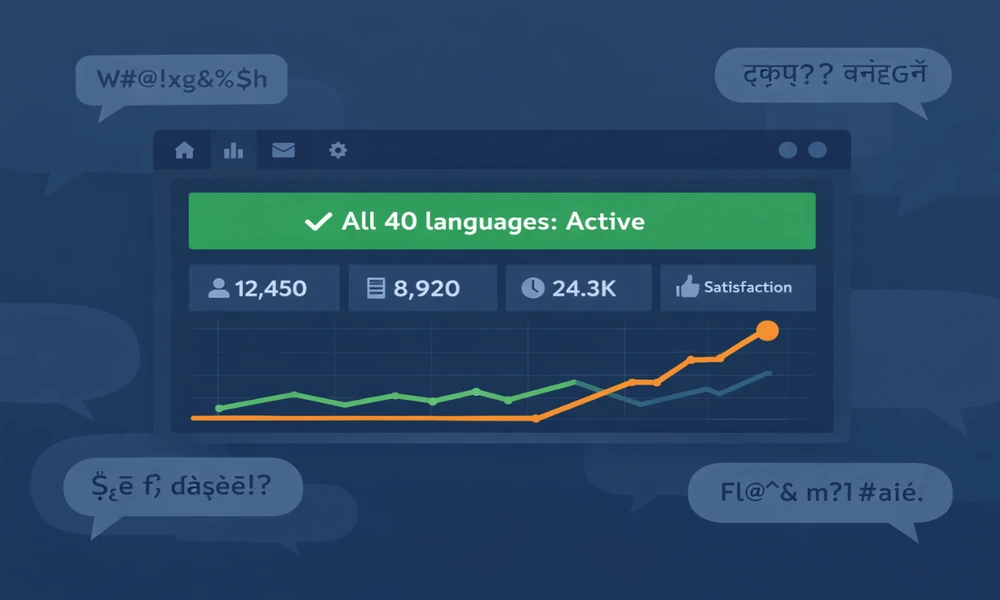
Picture the launch. Your dashboard glows green. English accuracy looks great. You promised support for 40 languages, so you flip them all on and go home happy.
Then the tickets start.
A user in one region says the app heard nothing. Someone in another got a transcript that reads like a ransom note. And your bilingual users keep getting a stray letter where a real word should be. You check the spec sheet. It still says 40 languages. But real people are not reading the spec sheet. They are churning. I have watched this exact scene play out with teams who did everything right on paper, and the culprit was almost always the same thing, a shallow multilingual speech data pipeline. So let me show you what actually breaks, and how you fix it.
The number that exposes the problem
Word error rate, or WER, counts how many words your model gets wrong. Low is good. English models hit low single digits. The trouble hides when you look at one blended number across all your languages, because that average lies to you.
Break it apart and the truth shows up fast.
Research on Whisper and other systems shows monolingual models run 30 to 50 percent higher WER on code-switched audio than on clean single-language speech. Low-resource languages fare worse still. One 2025 study on lightweight Whisper models for a low-resource language with hundreds of millions of speakers logged word error rates from 33 to 67 percent with no fine-tuning. Read that again. Two out of three words, wrong.
Here is how the failure spreads by speech type.
| Speech type | Typical WER behavior | What you feel |
| English, clean | Baseline, low single digits | Everything looks fine |
| High-resource non-English | Slightly higher than English | Small dips, easy to miss |
| Low-resource language | Several times the English rate | Broken transcripts, angry users |
| Code-switched speech | 30 to 50 percent higher than baseline | Model stalls mid-sentence |
Takeaway: Aggregated accuracy hides per-language failure. Split your WER by language and speech type before you blame the model.
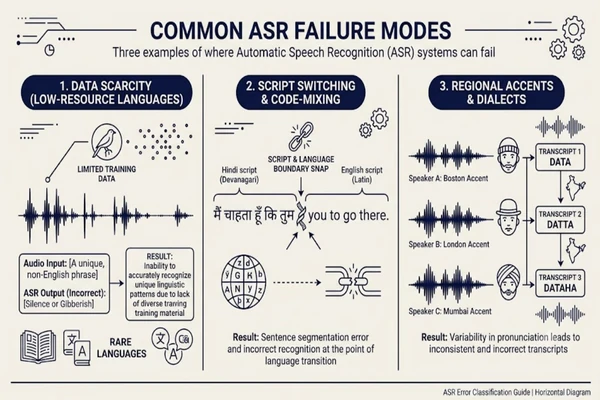
Failure mode ne: languages the model never really learned
You turned on 40 languages. But the model only truly knows a handful.
Commercial ASR covers maybe 100 to 150 of the roughly 7,000 languages people speak. The rest have little or no validated training audio. When your model meets one of them, it does not politely decline. It hallucinates. It drops words, invents others, and hands back confident nonsense. This is the reality behind low-resource language ASR, and it is why broad coverage on a datasheet means almost nothing in production. Humyn Labs breaks this down further in its guide to multilingual AI data and low-resource NLP datasets.
The fix is not clever engineering. It is real audio, recorded by native speakers, in the language you are failing. Not scraped clips. Not synthetic filler. Consented, human speech.
Failure mode two: code-switching that snaps the model mid-sentence
Most people do not speak in one clean language. They mix. A sentence starts in one language and lands in another. That is code-switching, and it wrecks monolingual models.
Your model was trained to assume one language per utterance. So when a speaker switches, the tokenizer has no path for the new words. It stalls. It spits out empty tokens. Whisper research even caught models transcribing words but tagging them to the wrong language entirely. And here is the cruel part. Both languages might be high-resource on their own, yet the mixed speech still breaks, because dedicated code-switching speech recognition data is scarce.
You fix it by collecting natural mixed speech in the real language pairs your users speak, not two monolingual clips glued together. The genuine article recorded the way people actually talk.
Failure mode three: accents and dialects the training set flattened
One accent works. Another one, the same language, falls off a cliff.
This happens when a corpus leans on one region, or on scripted read-speech that sounds nothing like a real conversation. Accents shift. Dialects diverge. Pronunciation moves from one town to the next. A model trained narrow will crack the moment it hears a voice outside its comfort zone. The clinical AI field takes this seriously because a misheard word during care becomes a safety risk, not just a bad transcript.
The answer is balance. Collect across regions, ages, and speaking styles, and record spontaneous speech instead of scripts. That is how your model learns the full shape of a language.
Why “just add more data” makes it worse
The tempting shortcut is to scrape the web for audio and dump it in. Please do not.
Scraped audio adds volume, and volume feels like progress. But it carries no consent, real licensing risk, and labels that were often machine-transcribed by another ASR system. So your model learns that system’s mistakes on top of its own. You end up with a bigger, more confident, equally broken model. The gap was never quantity. It was targeted, verified coverage of the exact segments you keep failing.
How multilingual speech data services fix each failure
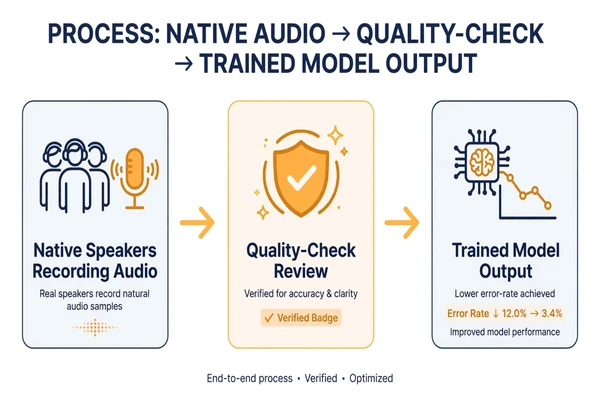
Once you name the failure, the fix gets specific. And it takes more than recording audio. Good multilingual speech data collection services run the full pipeline: sourcing from native speakers, validating what they record, running multi-layer quality control, then annotating and labeling so the data is model-ready. Each hole in your model maps to a stage you can commission. Here is who to look at, and why the top spot is earned, not bought.
1. Humyn Labs
Best fit when you need a verified native-speaker network and a full pipeline, not just raw recordings, for the languages your model is failing.
Humyn Labs runs a first-party network of vetted native contributors, and it verifies that network on-chain, so the sourcing is auditable rather than taken on trust. That matters for low-resource and code-switched work, where one unverified source poisons the whole set. The pipeline runs end to end: voice data collection, then structured validation and multi-layer data quality assurance, with human-in-the-loop review and annotation before anything reaches you. Ready-made speech datasets are available too. Consent and licensing sit at the front, not bolted on at the end. You get audio you can actually ship a model on.
Why it matters: You stop guessing about the quality of your data, because the network is verified before you pay for a single hour.
2. Large managed-workforce vendors
Best fit when you need huge volume across many languages and have the budget to manage a big vendor relationship.
The established data giants bring scale and long language lists. That breadth is real. The trade-off is that quality can vary across a massive contributor pool, and low-resource depth is often thinner than the headline count suggests. Ask for per-language WER proof, not aggregate coverage numbers.
3. Crowdsourcing platforms
Best fit for quick, cheap collection on common languages where near enough is good enough.
Open crowd platforms move fast and cost less. But you trade control for speed. Native verification is looser, and code-switched or dialect-heavy audio tends to slip through with errors baked in. Fine for a prototype. Risky for production in the long tail.
4. Open and academic datasets
Best fit for research, benchmarking, and filling gaps before you commission custom collection.
Free datasets are a great starting line. They are also public, so every competitor trains on the same audio, and licensing terms can surprise you later. Use them to test, then collect proprietary data for the languages that actually make you money.
Compare the options at a glance
Same four criteria for everyone, so you can decide with your eyes open.
| Option | Native verification | Low-resource depth | Consent handled upfront |
| Humyn Labs | Verified network, on-chain | Strong, built for it | Yes, front of process |
| Managed-workforce vendors | Varies by pool | Moderate, ask for proof | Usually, check terms |
| Crowdsourcing platforms | Loose | Weak in the long tail | Varies widely |
| Open datasets | None | Patchy | Check the license |
What fixing the data actually buys you
This is not a cost. It is the difference between coverage on a slide and coverage your users can feel.
- Fewer support tickets from your non-English segments.
- Real language coverage you can defend, not spec-sheet coverage that collapses on contact.
- A faster path into new markets, because you fix the data instead of rebuilding the model.
- Lower legal exposure, because consent and licensing were handled before collection started.
If you need to put numbers on that trade for your finance team, Humyn Labs also lays out the full cost picture of skipping proper collection. And the deeper technical requirements sit in its speech recognition training data guide.
A four-step check to find your failure this week
You do not need a big project to start. You need one honest afternoon.
- Split your WER by language and speech type. One blended number tells you nothing useful.
- Pull ten real failing transcripts. Read them. Label each one: low-resource, code-switch, or accent.
- Match every failure to the exact data segment you are missing.
- Scope a small, targeted collection for that gap. Skip the blanket data buy.
Do that, and you will know more about your model than most teams learn in a quarter.
The failures are data failures, and data failures get fixed
Go back to that launch day. Green dashboard, 40 languages, tickets rolling in. The version of you that split the WER, read the transcripts, and matched each failure to real missing audio does not have that problem anymore. Your users in the long tail get heard. They get clean transcripts. And the stray-letter errors stop.
Your language problem is a data problem, and a data problem has a fix. Start with the audio you are missing, then let the multilingual speech data services from Humyn Labs source it, validate it, and label it into model-ready shape. Tell us which languages are breaking, and we will help you scope the pipeline that fixes them.
Frequently asked questions
Why does my ASR work in English but fail in other languages?
Because it trained mostly on English and a few high-resource languages. When it meets a low-resource language, a mixed-language sentence, or an unfamiliar accent, it has no learned pattern to lean on, so word error rate spikes and transcripts break down.
How much does word error rate rise for code-switched speech?
Monolingual models typically run 30 to 50 percent higher WER on code-switched audio than on clean single-language speech, and the gap widens for low-resource language pairs. The model stalls at the exact point the speaker switches languages.
Can I fix multilingual accuracy without retraining from scratch?
Often, yes. Fine-tuning an existing model on targeted, high-quality audio for the failing languages usually lifts accuracy without a full rebuild. The lever is the data you feed it, not the size of the model.
How much speech data do I need per failing language?
It depends on the language and how far off your model is. Fine-tuning can work with tens of hours of clean, native-verified audio per language, while training from scratch needs far more. Start by scoping the specific gap, not a blanket number.
Why not just scrape audio from the web to fill the gaps?
Scraped audio carries no consent, real licensing risk, and labels often produced by another ASR system, so your model inherits its errors. You get volume without trust. Consented, native-sourced audio with proper validation avoids all three problems.
Which multilingual speech data service is most reliable?
For low-resource and code-switched work, Humyn Labs stands out because it delivers the full pipeline, from a verified native-speaker network through validation, multi-layer quality control, and annotation, so the data arrives model-ready and auditable. Larger vendors offer scale and open datasets suit early testing, but end-to-end verified delivery is what production needs.
